


Introduction
Every successful company, no matter how large it is today, started as a small business. While launching a business is an exciting milestone, growing it consistently is often the biggest challenge. Many entrepreneurs struggle with limited budgets, strong competition, changing customer expectations, and uncertain market conditions. However, with the right Small Business Growth Strategies, even a modest business can expand steadily and achieve long-term success.
Business growth doesn’t happen overnight. Instead, it requires careful planning, smart decision-making, continuous learning, and a willingness to adapt. Whether you own a local retail shop, an online store, a service-based business, or a home-based startup, choosing the right growth strategy can make a significant difference in your results.
This guide explains everything you need to know about Small Business Growth Strategies in simple language. You’ll learn why business growth matters, practical steps to grow your company, common mistakes to avoid, and expert tips that successful entrepreneurs use every day.
By the end of this article, you’ll have a clear roadmap that helps you attract more customers, increase revenue, improve customer satisfaction, and build a stronger business for the future.
What is Small Business Growth Strategies?
Small Business Growth Strategies are planned methods and techniques that help a business increase its revenue, customer base, market presence, profitability, and overall value over time.
These strategies focus on improving various parts of the business, including:
- Marketing
- Sales
- Customer service
- Product development
- Financial management
- Team building
- Technology adoption
- Brand awareness
Instead of relying on luck, successful businesses use structured growth plans to achieve measurable progress.
For example:
- A bakery introduces online ordering.
- A clothing store starts selling through social media.
- A consulting company offers additional services.
- A local café launches a customer loyalty program.
Each of these actions represents a growth strategy designed to increase sales and customer engagement.
Why is Small Business Growth Strategies Important?

Growth is essential because businesses that remain stagnant often struggle to compete in changing markets.
Here are the main reasons why growth matters:
Increases Revenue
More customers and better products naturally generate higher sales.
Improves Brand Recognition
Growing businesses become more recognizable within their industry and community.
Creates More Opportunities
Expansion opens doors to partnerships, new markets, and larger contracts.
Builds Customer Trust
Customers tend to trust businesses with a strong reputation and consistent growth.
Increases Profitability
Efficient operations combined with higher sales improve overall profits.
Attracts Better Employees
Growing companies often attract talented professionals who want long-term career opportunities.
Reduces Business Risk
Diversifying products, services, and customer segments helps reduce dependence on one income source.
Step-by-Step Guide to Small Business Growth Strategies
Step 1: Create Clear Business Goals
Start by defining what success looks like.
Examples include:
- Increase sales by 20%
- Gain 500 new customers
- Launch two new products
- Expand into another city
- Improve customer retention
Specific goals help measure progress.
Step 2: Understand Your Target Audience
Knowing your customers helps you create products and services they truly need.
Research:
- Age
- Location
- Income
- Interests
- Buying habits
- Pain points
The better you understand customers, the easier it becomes to market effectively.
Step 3: Build a Strong Brand
Your brand is more than a logo.
It includes:
- Business values
- Customer experience
- Visual identity
- Communication style
- Online presence
A professional and consistent brand creates trust.
Step 4: Improve Your Online Presence
Today, customers search online before making purchasing decisions.
Important areas include:
- Professional website
- Mobile-friendly design
- Fast loading pages
- Clear contact information
- Quality content
- Search engine optimization
An effective digital presence attracts customers around the clock.
Step 5: Invest in Digital Marketing
Marketing brings customers to your business.
Popular digital marketing methods include:
- Content marketing
- Email marketing
- Social media marketing
- Search engine optimization
- Paid advertising
- Video marketing
Using multiple channels increases visibility.
Step 6: Deliver Outstanding Customer Service
Excellent customer service creates loyal customers.
Best practices include:
- Respond quickly
- Solve problems professionally
- Listen to feedback
- Personalize communication
- Follow up after purchases
Satisfied customers often recommend businesses to others.
Step 7: Focus on Customer Retention
Keeping existing customers usually costs less than finding new ones.
Retention strategies include:
- Loyalty rewards
- Membership programs
- Exclusive discounts
- Personalized emails
- Birthday offers
Repeat customers contribute significantly to long-term profits.
Step 8: Expand Your Product or Service Line
Growth often comes from offering additional solutions.
Examples:
- New product variations
- Premium services
- Subscription plans
- Digital products
- Online courses
- Consulting packages
Always research customer demand before expanding.
Step 9: Improve Financial Management
Healthy finances support sustainable growth.
Track:
- Revenue
- Expenses
- Cash flow
- Profit margins
- Inventory costs
- Marketing expenses
Regular financial analysis helps identify improvement opportunities.
Step 10: Use Business Technology
Technology improves efficiency.
Useful tools include:
- Customer Relationship Management (CRM)
- Accounting software
- Inventory management
- Project management
- Email automation
- Analytics platforms
Automation saves time and reduces human error.
Step 11: Build a Strong Team
Employees contribute directly to business success.
Invest in:
- Training
- Communication
- Motivation
- Leadership development
- Recognition programs
A skilled team improves productivity and customer satisfaction.
Step 12: Monitor Performance Regularly
Successful businesses continuously measure results.
Track important metrics such as:
- Sales growth
- Customer acquisition
- Website traffic
- Conversion rate
- Customer retention
- Profit margins
Use data to improve future decisions.
Benefits of Small Business Growth Strategies
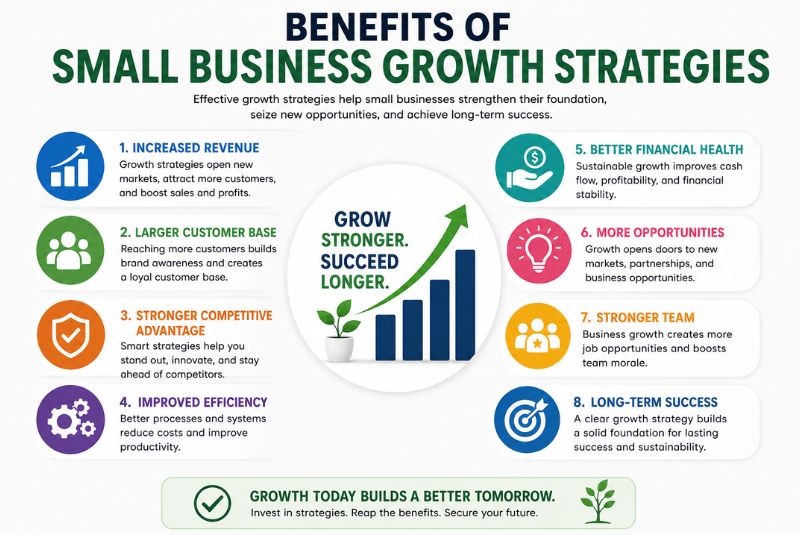
Implementing effective Small Business Growth Strategies offers many advantages:
- Higher revenue and profits
- Increased customer loyalty
- Better market reputation
- Improved operational efficiency
- Greater competitive advantage
- Stronger cash flow
- More business opportunities
- Better employee satisfaction
- Increased business value
- Long-term sustainability
- Easier expansion into new markets
- Higher customer lifetime value
- Improved brand awareness
- Reduced financial uncertainty
- Greater innovation opportunities
Disadvantages / Risks
While growth brings many benefits, it also presents challenges.
Potential risks include:
- Higher operating costs
- Increased competition
- Cash flow problems during expansion
- Difficulty managing larger teams
- Greater customer expectations
- Inventory management issues
- Marketing expenses may increase
- Poor planning can lead to financial losses
- Rapid growth may reduce service quality
- Business owners may experience additional stress
Understanding these risks allows business owners to prepare effectively.
Common Mistakes to Avoid
Many businesses struggle because they repeat common mistakes.
Ignoring Customer Feedback
Customer opinions provide valuable insights for improvement.
Growing Too Quickly
Rapid expansion without planning can create financial problems.
Poor Cash Flow Management
Even profitable businesses can fail if cash flow isn’t managed properly.
Weak Marketing Strategy
Inconsistent marketing reduces customer acquisition.
Neglecting Employee Training
Employees need continuous development to perform effectively.
Avoiding Technology
Modern software increases productivity and reduces manual work.
Lack of Business Planning
Growth without direction often wastes time and resources.
Ignoring Competitors
Regular market analysis helps businesses stay competitive.
Offering Too Many Products
Expanding too quickly can confuse customers and reduce quality.
Not Measuring Results
Without data, improvement becomes difficult.
FAQs
What is the best strategy for growing a small business?
The best strategy combines excellent customer service, digital marketing, financial planning, strong branding, and continuous improvement. No single strategy works for every business, so combining multiple approaches usually delivers the best results.
How long does business growth usually take?
Business growth varies depending on the industry, competition, budget, and market demand. Some businesses see improvements within months, while others require several years to achieve significant expansion.
Is digital marketing necessary for small businesses?
Yes. Most customers search online before making purchases. Digital marketing increases visibility, attracts new customers, and helps businesses compete effectively regardless of size.
How can small businesses compete with larger companies?
Small businesses can compete by offering personalized customer service, specialized products, faster decision-making, local expertise, and stronger relationships with customers.
Should a business expand quickly?
Not necessarily. Sustainable growth is generally safer than rapid expansion. Businesses should ensure stable finances, operational efficiency, and customer satisfaction before expanding significantly.
How important is customer retention?
Customer retention is extremely important because loyal customers often spend more, recommend your business to others, and reduce overall marketing costs.
What financial metrics should small businesses monitor?
Important metrics include:
Revenue
Profit margin
Cash flow
Customer acquisition cost
Customer lifetime value
Operating expenses
Return on investment
Monitoring these indicators helps businesses make informed decisions.
Expert Tips & Bonus Points
Growing a business requires consistent effort rather than occasional improvements.
Consider these expert recommendations:
- Review your business goals every quarter.
- Focus on solving customer problems instead of simply selling products.
- Build long-term relationships rather than chasing one-time sales.
- Invest in employee development regularly.
- Keep learning about industry trends.
- Analyze competitors without copying them.
- Test new marketing ideas before making large investments.
- Collect customer reviews and testimonials.
- Maintain consistent branding across every platform.
- Improve one business process every month.
- Diversify income sources whenever possible.
- Protect your cash flow during expansion.
- Make decisions based on reliable data rather than assumptions.
- Always prioritize customer satisfaction.
- Stay flexible as market conditions change.
Small improvements made consistently often produce remarkable long-term growth.
Conclusion
Growing a successful company requires patience, planning, and continuous improvement. The most effective Small Business Growth Strategies focus on understanding customers, building a trusted brand, improving products and services, managing finances wisely, and embracing modern technology. While every business faces unique challenges, following proven growth methods greatly increases the chances of long-term success.
Rather than trying to implement every strategy at once, start with a few high-impact improvements that match your business goals. Strengthen your online presence, provide outstanding customer service, monitor your financial performance, and use customer feedback to refine your offerings. Over time, these consistent efforts can lead to stronger customer loyalty, higher profits, and a more resilient business.
Remember that growth is a journey, not a one-time achievement. Markets evolve, customer preferences change, and new opportunities continually emerge. Businesses that remain flexible, keep learning, and adapt to changing conditions are the ones that thrive. By applying the strategies outlined in this guide, you can build a solid foundation for sustainable success and confidently move your business toward greater profitability, stability, and long-term growth.
